
Curriculum Making With Generative AI
A win-win cycle of teaching as a designer of learning.
We believe AI can be used in schools to reclaim your classroom as a space of curriculum control, creativity, and customization that puts students first- not offloading. Move away from patchwork solutions toward a collegial model for PLCs.
Online Self-paced course: Establishing the Shared Baseline
$300
How should school leaders and PLCs set up an AI infused workflow, enjoying curriculum design as a challenge that models for all students life-long learning. Enjoy 16 lessons that ensure you are using AI to assist you improve your units.
1. 16 Lessons - Live on 18.5.2026
2. Digital interactive community. Live on 18.5.2026
3. Digital and printable tasks for you and your PLCs. Live on 18.5.2026
4. Automatic free registration to all workshops (optional attendance)
WORKSHOPS This online course includes free optional attendance at our 1- hour upcoming online workshops
Or $55 each
LLM Skills
20.7.2026 3:45pm
Data-led Customisation
3.8.2026 3:45pm
Grounding Your Prompts: The Document Strategy
17.8.2026 3:45pm
Find out more about our options for schools
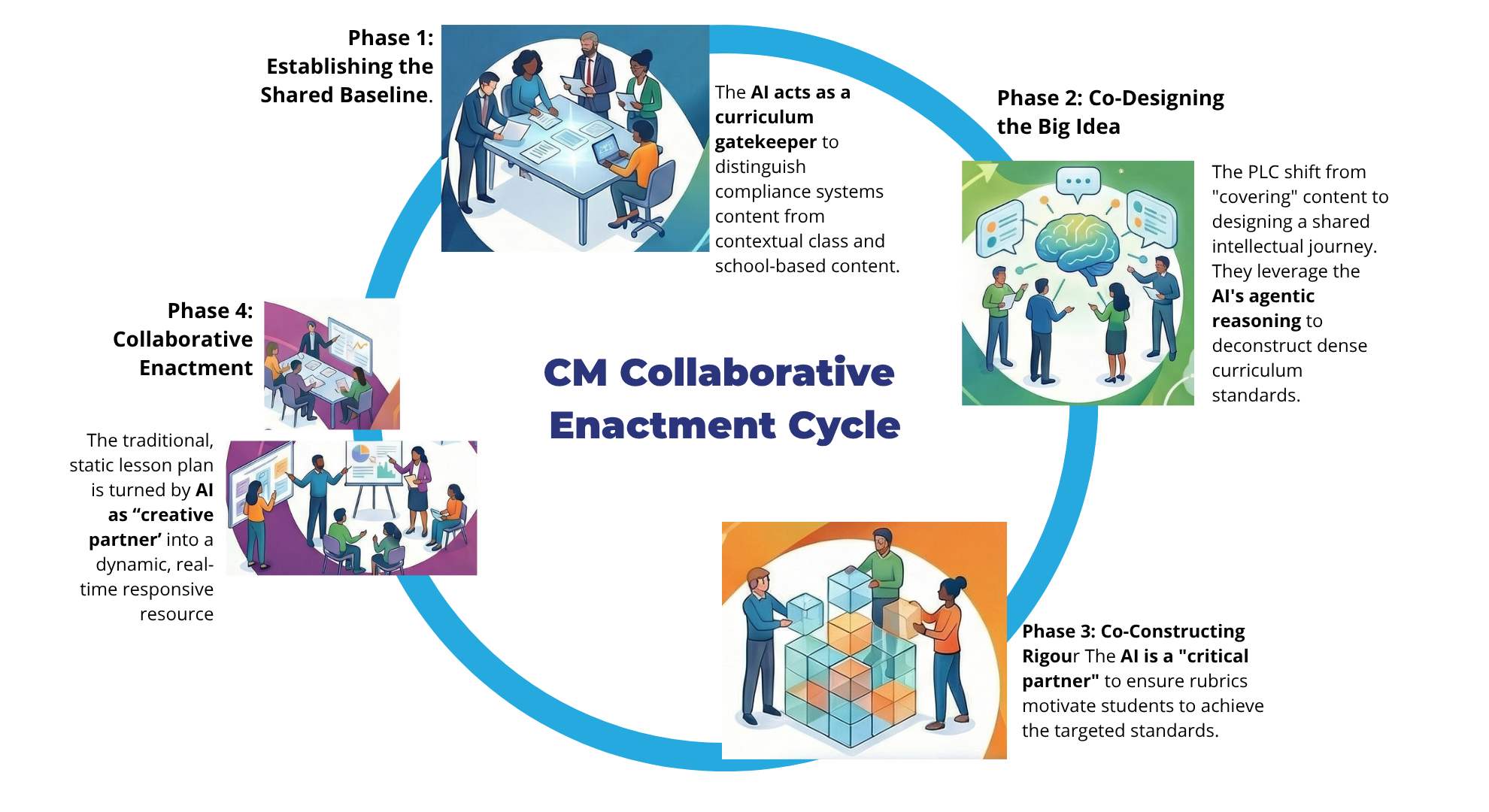
Phase 1. What does 'Establishing the Shared Baseline' mean?
This phase is all about starting well - as much physically as conceptually.
The advent of Large Language Models has been called 'the 4th Industrial Revolution'. It is a very big change to have a technology that can no longer be classified a 'tool' but an 'agent'.
We've created one-page examples of our own experiences when using AI in our teaching workflows.
1.1: We Teachers & Our Curriculum Materials
1.2: We Value Our Context
1.3: Why We Keep 'AI On A Leash'
1.4: We Teachers Straddle Compliance & Creativity
Phase 2. What does 'Co-designing the BIG idea' mean?
If Phase 2 is about enabling the PLC to go from "covering" content to designing a shared intellectual journey. Together they "train" the LLM to help grow the their professional knowledge on how students learn best when they set their own their learning goals
2.1: How AI supports us acknowledging prior knowledge
2.2: When do we infuse AI assistance to map our students' progress?
2.3: How do we use AI to (re)draft a 'scope and sequence'?
Phase 3. What does 'Co-constructing Rigour' mean?
If Phase 2 is about finding the Big Idea, Phase 3 is about enabling your students demonstrate that they learned it. In this phase, we tackle the heavy administrative lifting of teaching, rubrics and grading, by shifting your mindset from treating assessment as a retrospective afterthought to treating it as the rigorous anchor of your entire unit.
3.1: How we blended Differentiated Instruction with Backward Design?
3.2: How can AI show us the validity of the summative assessment?
3.3: How we used AI to link formative and summative assessments.
Phase 4. What does 'Collaborative Enactment' mean?
Traditionally, the "daily lesson plan" is where planning both begins and ends. You stare at a blank proforma, fill in the boxes, and hope it survives contact with the classroom. In the final phase of the Curriculum Makers methodology, you will learn that the daily plan can be responsive and ongoingly vital.
4.1: How do we get AI to 'instantly' help us align learning outcomes?
4.2: How do we get AI to help us find the best sequence?
4.3: How does AI help us to create responsive daily lesson plans?
Special Note: "On telling the dancer from the dance"
As a new organisation, our visual aids are still in the making (literally with our graphics designer, Francis Lim).
We have used AI for drafting concepts based on our research of last 18 months.
Dr De Rossi has written numerous versions of curriculum design ideas based on updating units of work from her own teaching portfolio.
These papers and drafts have been used to inform images and processes on this page. Dr De Rossi is always happy to share and discuss the papers that feed this landing page.