
Using AI to Learn About the Framework for GenAI in Schools
Try the Interactive AI Policy Assistant
Test your school's AI guidelines, generate staff meeting scenarios, or build EdTech vendor procurement questions in real time. Grounded directly in the Australian Framework, 25 Guiding Statements, and ESA National Product Expectations.
Your simply requires a free Google account to launch in Gemini.
GET STARTED ON THE NATIONAL FRAMEWORK ASSISTANT: Open the document to see how we put together the Google Gem. See examples of four prompts which we tested the quality of its assistance.
The Eight Policy Paper With 112 Related Issues!
When we analysed the Australian Framework for Generative Artificial Intelligence in Schools , we found that it could be directed linked to 112 educational issues. These also include the key curriculum organisations and researchers that compose the document, together with their identification of legislation, knowledge, concepts and skills required for embedding the six principles into the workings of the school community. We’ve set these 112 issues out on our Australian AI Framework Index.
Given that the document is rich with references, we then analyse our needs as curriculum developers to utilise its guidelines. We decide to put a GEMINI GEM to work. GEM is not an acronym. Instead, it is a brand name and a play on Gemini—a metaphor for a specialised, custom AI assistant carved out of the broader Gemini model (similar to how OpenAI calls custom assistants "GPTs").
Good policy like good nutrition must be ‘taken in’.
If you’re a baby-boomer you might remember the 1970s “Go on Freddie, drink it!” advertisement for Nestle’s QUIK. The ads featured a character trying to get a boy named Freddie to finish his milk. Milk was described as a "big white vitamin pill" packed with nutrients. Adding Quik turned plain milk into popular chocolate or strawberry flavours.
The advert came to mind as I read the Australian Secondary Principals Association’s blog (22 July, 2025) recommending Australia’s national AI framework.
The Australian Framework for Generative Artificial Intelligence in Schools is a useful resource for schools to effectively and ethically plan for the use of Gen AI in teaching and learning. It was developed through consultation with education departments, non-government sector peak bodies, ACARA, AERO, and AITSL. The Framework provides high-level professional guidance to principals and teachers in the appropriate use of Gen AI in schools.
To the point, what are school principals using to ensure their staff interact with the ‘big white vitamin pill’ of principles and practical guidelines? More worryingly, how are curriculum leaders counting the cost of staff not dealing with the pedagogical and existentialist issues bolted into the Framework’s economical, dense language?
Let’s push the metaphor of good policy as good nutrition a little further. How are schools ensuring that their curriculum leaders and classroom teachers are sustained on a diet of the six principles set out in the Australian Framework for Generative Artificial Intelligence in Schools? Such a question is crucial given the time squeeze we have in schools for doing anything more than the basic exploration of content. In short, it boils down r, how are they being served the knowledge, understanding and skills in three crucial documents:
Let’s look at what these contain.
The Core National Framework (October 2023)
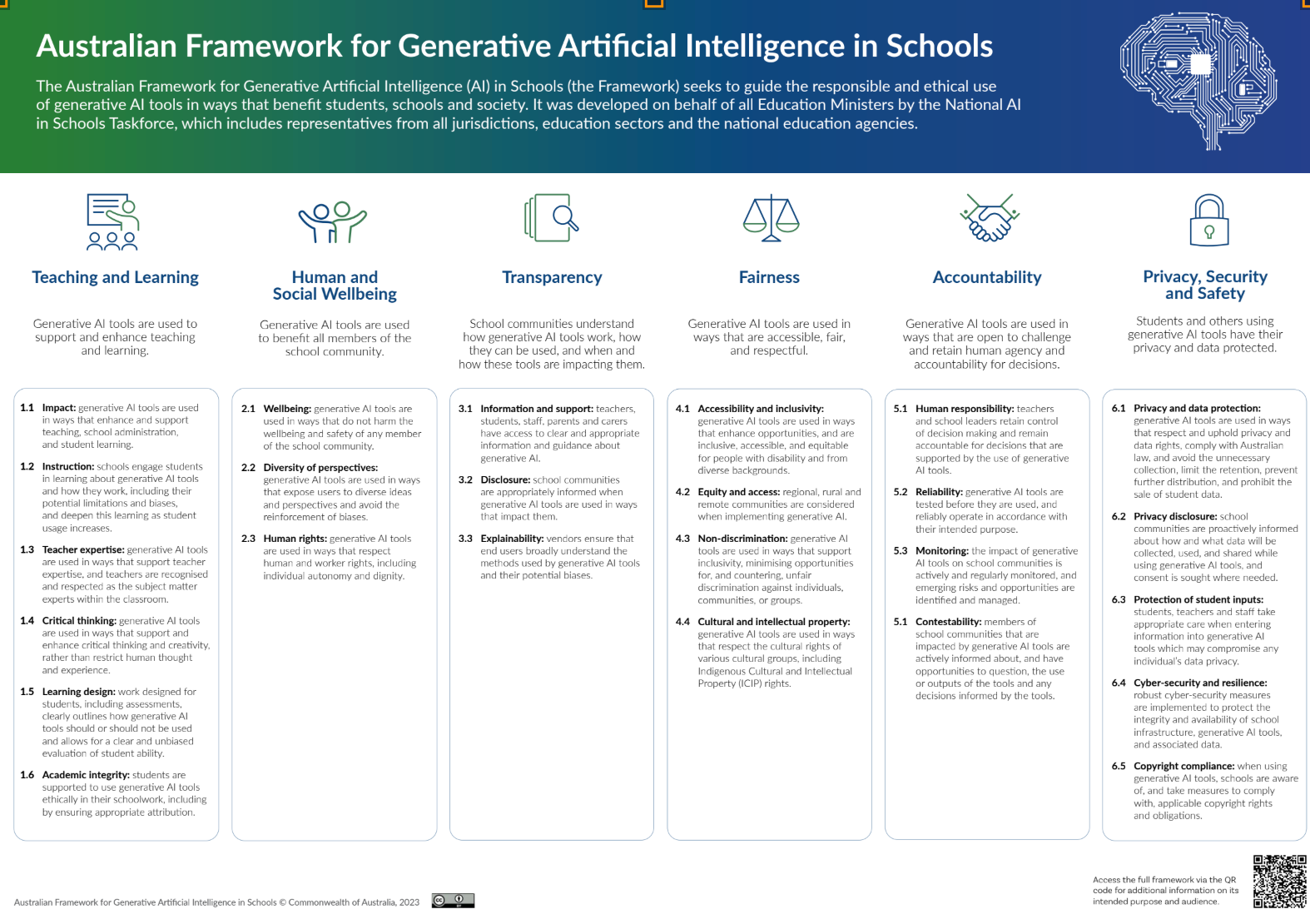
The six principles in National Framework are designed to ensure that generative AI tools help “Australian school communities (students, teachers, staff, parents and carers) support education outcomes, ethical practices and equity and inclusion.”(p.3)
With the first principle of ‘Teaching and Learning’ leading the document’s focus, the reader is called onto viewing AI as the generator of “new content… that resembles what humans can produce.” (p. 3) Little wonder then that the first principle concerns itself with distinguishing between who or what does the learning by calling on the need to outline clear rules for assessments and academic Integrity.
Principle 2, ‘Human and Social Wellbeing’, begins the focus through all following five principles to prioritise safety and avoid harm. For instance, in Principle 3 ‘Transparency’ school communities are required as not only needing to be being informed when and how AI impacts them, but requiring the producers of the technology to hold the school’s need to be protected against biases and misinformation.
In the fourth principle ‘Fairness’, AI use is outlined as needing to be necessarily inclusive, accessible, and respectful of Indigenous Cultural and Intellectual Property (ICIP) rights. The implication of upholding an Australian democratic ethos is presented as a constant aspiration.
This is followed by Principle 5 ‘Accountability’ as a clear direction for teachers and school leaders to not only retain human control over GenAI, but they will be also considered responsible for all decision-making in using new technologies. The parameters of much of what they means legally is outlined in Principle 6 ‘Privacy, Security and Safety’. The mention of privacy and copyright legislation, the Copyright Act 1968 and the Privacy Act 1988, are areas now requiring more overt consideration in everyday school life.
The six principles and then also offer in a Poster version of the Framework, through an overarching statement of intent, followed by highly specific, numbered sub-guidelines
The 2024 Review Update (Endorsed June 2025)
The annual review, endorsed by Education Ministers in June 2025, confirms that the National Framework has been highly effective. It is built on predicting emerging modern classroom risks, such as the rise of AI-generated deepfakes. Crucially, the review highlights three crucial developments shaping how schools operationalise these rules in 2024–25:
ACARA v9 Integration ("Curriculum Connections"): This is a joint initiative by AITSL and AERO that officially integrates AI planning guides and AI content elaborations directly onto the ACARA Version 9.0 curriculum website, providing teachers with explicit pathways to teach about AI within standard subjects.
National Product Expectations (ESA / ST4S): Led by Education Services Australia (ESA), the government is establishing unified standards for EdTech developers. This project is designed to force AI vendors to build tools that strictly respect student privacy and data security before they are allowed into school networks.
A Focus On Equity
Furthermore, theNational AI in School Taskforcetargets National Equity Research on how generative AI impacts student learning outcomes, specifically focusing on closing gaps for historically disadvantaged cohorts. The initiative comes from the AI in Practice working group co-led by the Australian Education Research Organisation (AERO) and AITSL. Its goal is to move beyond speculative claims and generate empirical evidence on how generative AI impacts student learning, ensuring technology actively closes educational gaps rather than widening them.
The target cohorts being examined are first nations students through evaluating how GenAI tools perform for indigenous learners while embedding safeguards around Indigenous Cultural and Intellectual Property (ICIP) and Indigenous Data Sovereignty. The second cohort focused on are regional, rural, and remote communities by investigating structural barriers such as bandwidth constraints, device access, and geographic digital divides. Another cohort consists of students with disability and diverse needs by studying GenAI's potential as an adaptive assistive tool (e.g., real-time text simplification, multi-modal translation, scaffolded instruction). The fourth group are low socio-economic status (SES) cohorts by measuring access equity to ensure low-resource schools aren't left using inferior AI models while high-SES schools utilise premium educational integrations.
Core Research Objectives
The working group looks in detail at ‘Closing the Achievement Gap’ initiative, assessing whether AI-driven personalised feedback helps students below national minimum standards catch up in foundational literacy and numeracy. Crucially, it also identifies algorithmic bias by analysing commercial LLMs propensity for cultural, linguistic, or regional biases.
Most importantly, it provides principals with concrete research rather than vendor marketing when choosing AI platforms for their schools through evidence-based tool selection. It also aligns with the equity goals of The Alice Springs (Mparntwe) Education Declaration.
Back To Our Curriculum Makers Gem
Here’s a good overview of Gemini’s Gem tool in case you have not come across it.
Try the Interactive AI Policy Assistant
Test your school's AI guidelines, generate staff meeting scenarios, or build EdTech vendor procurement questions in real time. Grounded directly in the Australian Framework, 25 Guiding Statements, and ESA National Product Expectations.
Requires a free Google account to launch in Gemini.
GET STARTED ON THE NATIONAL FRAMEWORK ASSISTANT: Open the document to see how we put together the Google Gem. See examples of four prompts which we tested the quality of its assistance.
