
Have you read the Castlereagh Statement? You should!
Apr 03, 2026
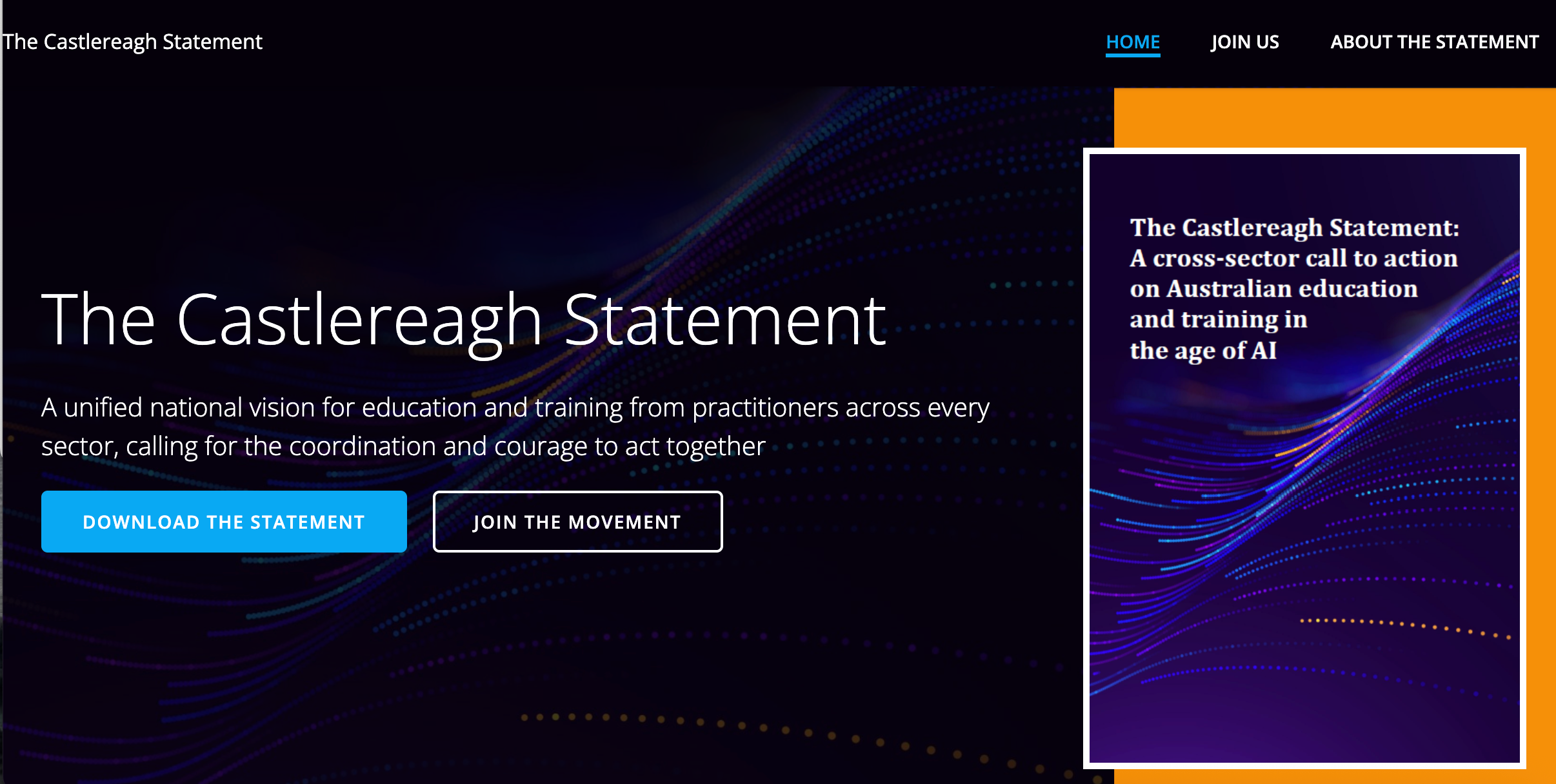
This response to the Castlereagh Statement is in two parts. In this blog, I share how I see it as a vital initiative in shaping the next steps in AI in education. In the second blog, I reflect on the vitalness of its second principle,
So, I hope my critique of its goals and principles can contribute to its full discussion.
When I 'stumbled' across it on LinkedIn, the discovery proved to me that its hard in an information-dredged age to 'keep up' with important information. Furthermore, it took some searching to find the website that outlines its origins and future development.
Nonetheless, as a curriculum designer working to implement a pedagogy-first approach with AI in the classroom, I am elated that the Statement's mission is to be
the voice of a grassroots community of educators, leaders, and students speaking to one of the most urgent challenges facing Australian education, and offering a shared way forward.
Make No Mistake, This Is A Pivotal Moment
Arguably, while the collective focus of AI in Education to date has been on "AI Literacy" and "Safe Use" guidelines, in a visionary move, facilitators of the Statement, Professors Danny Liu (USYD), Jason Lodge (UQ) and Microsoft Executive, Katie Ford, have moved towards a systemic Australian-based approach. The AI jargon for this, I believe, is known as defining one's 'sovereign capability'. At Curriculum Makers, we're hoping it means that every teacher, in every classroom get to confidently interacting with AI. Consequently, dealing with 'an agent' rather than just a tool, means tackling philosophically vexing issues and practical processes, first and foremost, pedagogically.
Broadcasting a collective vision of AI in Education
The National Summit in October 2025 that gave rise to the Statement was hosted by the University of Sydney at its Castlereagh Street campus, hence the Statement's title. The diverse representation present at the gathering brought together a wide range of stakeholders, including representatives from schools, vocational education and training (VET) providers, universities, Government departments, accrediting bodies and leading organisations from the professions, industry, and the arts.
The Statement's structure is driven by three goals and six principles. These are then 'operationalised' through "a three-horizon framework for action. The near horizon to address urgent stabilisation... the medium horizon drives necessary structural transitions... The far horizon lays new foundations for education and training models centred on valued human capabilities."
As I examine its first goal of "A shared definition of what we value in human learners and educators, with aligned measurement systems", I am excited to press on and review how its six principles might realise such a bold vision. What lessons might we have learned from the implementation of the Australian Curriculum? How will they build the Statement on the foundations of the 2019 Alice Springs (Mparntwe) Education Declaration (Education Council, 2019)? How will they embed the Declaration's ethos into human-machine interactions?
So then, reading the Statement's preamble, I note that there's a conscious intention for avoiding to declare "the architecture of the solution". This makes me even more curious about how the challenge ahead will not just be about coming up with the 'unified vision' but devising a constructive and inclusive process through which the vision can be realised.
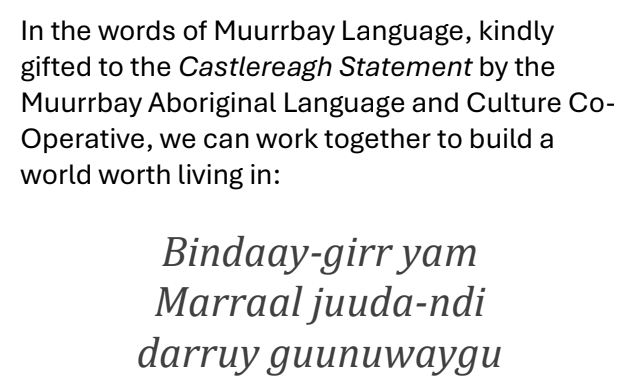
As the words in the preamble allude to the Muurrbay Aboriginal Language and Culture Co-operative, it seems to me they appropriately ask us to see the work ahead as building "a world worth living in".
The Castlereagh Statement calls for a collective agency at a pivotal moment in Australian education. It provocatively challenges us to review how Generative AI is matching cognitive tasks which our current systems were built to develop and assess. How can we ignore addressing the AI's agentic capacity? The simple answer is, we can't.
Dear Principals & Curriculum Leaders
Use the link here to learn more about us and join our free AI Curriculum Makers Community. Think of the Community as a space in which you need for information meets the equal need to share your views on AI in Education. We welcome PLCs who are undertaking a special curriculum inquiry - post, talk and watch demonstrates of curriculum explorations.
Stay connected with news and updates!
Join our mailing list to receive the latest news and updates from our team.
Don't worry, your information will not be shared.
We hate SPAM. We will never sell your information, for any reason.